The beginning of the 19th century
It is in the middle of the 19th. century that we first hear of lingerie in the modern sense of the word, for which we have to thank a business like FELINA with its history spanning more that 120 years.
Corset, crinoline and bustle are terms which concerned a woman between 1810 and 1870. The fashion-conscious woman appeared with a "wasp waist” created then by laced-up bodices and mechanical corsets. Around 1870 the artificially lifted silhouette slipped to the back and the basket-shaped bustle created the erotically charged "false posterior”.
The last third of the 19th century brought with it even more luxury in lingerie. Fine Dutch linen or batiste, embroidery and lace work, heart-shaped broderie anglais or crochet work. Imagination knew no bounds. The art of “white needlework” had begun.
The corset that so far had been used exclusively to give shape to the figure thus acquired an extra fashionable accent by the so-called rubber garters that we know today as "suspenders”.
The end of the 19th century
The typical 1900 silhouette shows the woman without a stomach - better still with a concave stomach, and in its place emphasise the bosom and prominent posterior. From 1910 the lower half of the body was forced into a straight line.
The history of industrialisation shows that up to the 1840s corsets were made to measure and individually hand sewn by the corsetier. Afterwards mass production came along linked to the weaving of the corset on a handloom. From 1850 the sewing machine was in use in Germany.
The French were the forerunners of standardised corset production. A little later, around the middle of the 19th century, the first corset sewing works appeared in Germany. Among them was a factory in Bad Rappenau founded in 1885 and known later as FELINA.
The first precursor of the bra was the “Callimaste”, the French model shaped from flexible strips and worn under the corset.
The First World War gave rise to a completely new feminine image conditioned by the necessity of employing women and their subsequent independence. Women suddenly began to resemble young men or boys. The one-piece was the most up to date item of clothing. Bosoms disappeared under the first bras and the corset were partially replaced by the girdle.
The beginning of the 20th century
America in the 1920s saw the rise of “vamps” - well proportioned but slim hipped. The lingerie basics were rounded bras that emphasised the bust, the elasticised girdle and the figure-hugging support corset. Indispensable: the girdle, which until the invention of tights also doubled as a suspender belt.
The Second World War meant shortages and hence inventiveness. Foreign fibres like Nylon and Perlon appeared on the German market. Lingerie basics now consisted of a girdle and bra.
1960 until now
The start of the 60s saw a huge expansion in the West German lingerie industry. It employed 25,000 people with 2,000 employed by FELINA alone. The wonder fibre Lycra, the first tights and the mini-skirt became fixtures in the fashion industry.
The days when women preferred to buy undergarments, particularly corsetry, in secret and with a certain embarrassment are, thank goodness, long gone. In the last ten years corsetry and underwear have been seen more and more as fashion items. This is due partly to more enlightened times and partly to increased body awareness.
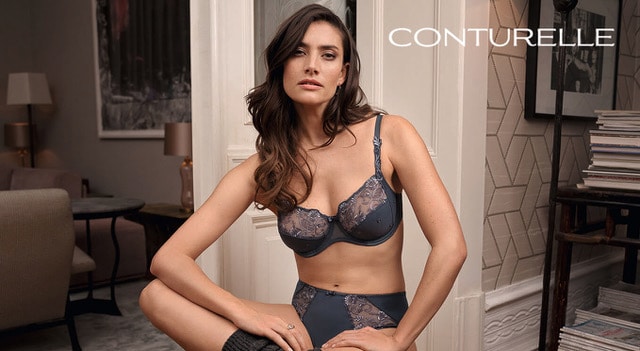
The current vogue for designs aimed at emphasising the figure, and deeper decolletés, has had a considerable influence. Another factor is that there are increasing numbers of young women with large bosoms who are not afraid to emphasise their decolletés. Quite apart from the fashion aspect - ranging from sporty models to elaborately feminine styles - clients are setting increased store by a well-fitting bra. While fulfilling the demand for fit and support, the finished product must not be too conservative in style or evoke images of Granny’s corsets.
Women with large cup sizes are particularly fashion-conscious and insist not only on a comfortable fit, but also on high fashion and superior quality. Undergarments should not constrict the wearer, but be comfortable and create a particular feeling of well-being.
Sources:
„Zur Geschichte der Unterwäsche 1700-1960“, Almut Junker, Eva Stille, Historisches Museum Frankfurt am Main
„Wäsche, Mode Markt und Marketing“, Felicitas Bachmann, Christa Madeyka, Mechthild Meyer-Schneidewind, Deutscher Fachverlag